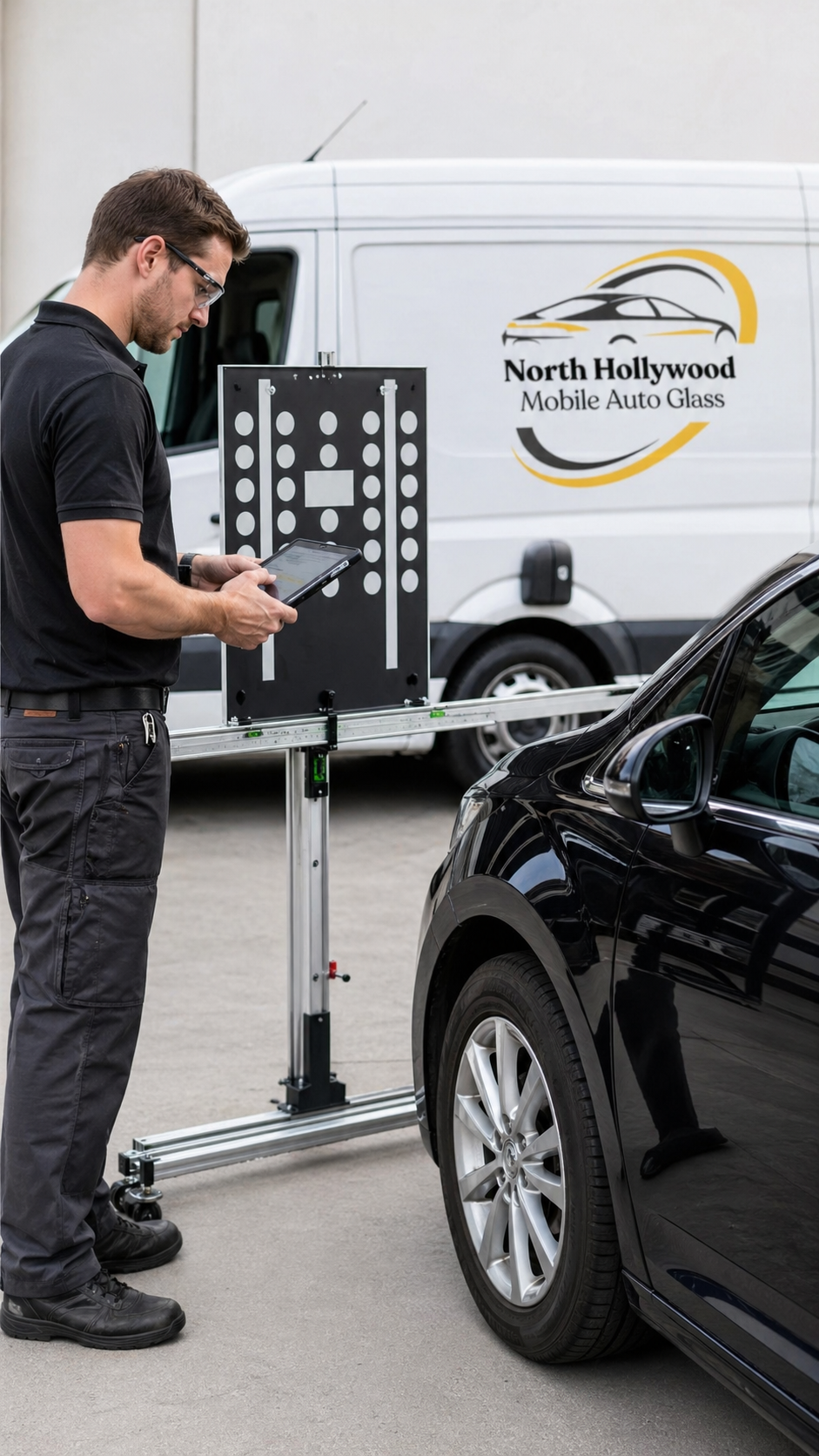
Get reliable calibration support for vehicles with camera-based safety systems, service alerts, or post-glass replacement recalibration needs.
ADAS calibration aligns the windshield camera and safety sensors that support lane assist, forward collision warning, automatic emergency braking, adaptive cruise control, and other driver assistance systems.
North Hollywood Mobile Auto Glass helps vehicle owners request professional ADAS calibration service after windshield replacement, camera disturbance, dashboard warning lights, or safety system alerts.
Your vehicle may need ADAS calibration when a windshield-mounted camera, vehicle module, safety sensor, or driver assistance system has been moved, replaced, disturbed, or flagged by the vehicle’s diagnostic system.
Many ADAS-equipped vehicles require windshield camera calibration after windshield replacement. The forward-facing camera may be attached to the glass, mounted near the rearview mirror, or positioned through a camera bracket. When the glass changes, the camera angle and field of view may need to be recalibrated to OEM specifications.
ADAS recalibration may be needed if a camera sensor, radar sensor, camera bracket, mirror assembly, or related component has been removed, shifted, disconnected, or disturbed during service. Even small position changes can affect how the vehicle reads lane markings, vehicles, pedestrians, and road objects.
Dashboard warning lights, ADAS warning messages, camera blocked alerts, lane assist errors, collision system alerts, or stored fault codes can point to a calibration issue or system fault. A diagnostic scan can help identify whether the vehicle needs recalibration, inspection, or another safety system service.
Collision repair, front-end repair, suspension work, wheel alignment changes, or sensor replacement can affect ADAS accuracy. If the vehicle’s camera or sensor geometry changes, professional recalibration may be needed to restore safety feature accuracy.
ADAS calibration supports the vehicle safety systems that rely on cameras, sensors, vehicle modules, and manufacturer-defined calibration data. The exact recalibration requirement depends on the make, model, trim level, windshield type, and ADAS package.
Uses camera input to detect lane markings and alert the driver when the vehicle drifts.
Uses camera and steering data to help the vehicle remain centered within lane markings.
Uses sensor and camera input to detect vehicles, objects, and closing distance ahead.
Uses ADAS data to help trigger braking response when a collision risk is detected.
Uses front-facing detection systems to help maintain following distance.
Uses vehicle sensors to detect vehicles near adjacent lanes.
Uses camera data to read posted signs and display vehicle alerts.
Uses cameras and sensors to support low-speed parking visibility.
Uses multiple camera angles to support visibility around the vehicle.
If one of these systems behaves differently after glass service, repair work, warning lights, or sensor disturbance, ADAS calibration service may be the correct next step.
ADAS calibration can involve static calibration, dynamic calibration, or both. The required method depends on the vehicle manufacturer, ADAS system design, camera location, sensor package, diagnostic scan results, and make and model procedure.
Static ADAS calibration uses fixed calibration targets, controlled vehicle positioning, measurement-sensitive setup, and manufacturer specifications. This method is often used for alignment-sensitive windshield camera systems that require precise target recognition before the safety system can verify camera position.
Dynamic ADAS calibration is completed through a road-based calibration process under manufacturer-defined driving conditions. The vehicle may need to read lane markings, traffic patterns, speed ranges, and environmental inputs while the system completes its calibration routine.
Certain vehicles require both static and dynamic ADAS calibration. Others require only one method. A diagnostic scan, vehicle system check, calibration target requirement, and manufacturer procedure review help confirm the correct calibration path for the vehicle.
North Hollywood Mobile Auto Glass keeps the ADAS calibration process focused on safety, accuracy, diagnostic review, and proper calibration path selection. The goal is to help vehicle owners address windshield camera and driver assistance system concerns with professional calibration assistance.
The vehicle, windshield camera, sensor area, camera bracket, and safety system concerns are reviewed.
A scan helps identify ADAS warning lights, stored fault codes, system faults, vehicle module issues, and calibration readiness.
The forward-facing camera, mounting area, sensor location, and related components are checked for service-related concerns.
The vehicle requirements are matched to static calibration, dynamic calibration, or both.
Calibration is completed according to the required make and model procedure, equipment needs, and system requirements.
The system is reviewed after calibration to support safety feature accuracy and system readiness.
This professional process helps reduce the risk of misaligned cameras, inaccurate lane detection, unreliable collision alerts, unresolved warning messages, and incomplete recalibration requirements.
ADAS systems depend on accurate camera alignment, sensor positioning, vehicle module communication, and manufacturer-level calibration data. If the windshield camera is even slightly misaligned, driver assistance features may not read the road correctly.
A misaligned camera can affect lane detection, forward collision alerts, automatic emergency braking response, adaptive cruise control behavior, traffic sign recognition, and other safety functions. The vehicle may still drive normally, but the ADAS system may not interpret its surroundings accurately.
Professional ADAS calibration helps return the camera and related safety systems to manufacturer specifications. That matters after windshield replacement, camera bracket movement, collision repair, sensor service, warning light activity, or a glass replacement claim.
If your vehicle shows ADAS warnings or recently had windshield service, contact North Hollywood Mobile Auto Glass before relying on lane assist, collision alerts, or automatic braking features.
North Hollywood Mobile Auto Glass helps vehicle owners get ADAS calibration support after windshield replacement, warning lights, camera disturbance, or sensor-related service needs.
ADAS calibration depends on the vehicle make, model, windshield type, camera location, and safety system package. We help identify the correct calibration path for your vehicle.
A windshield-mounted camera supports lane assist, forward collision warning, adaptive cruise control, and automatic emergency braking. Calibration helps restore accurate camera alignment after glass or sensor disturbance.
Some vehicles need static calibration, dynamic calibration, or both. We help confirm the proper requirement before service.
Warning lights, fault codes, and ADAS alerts can point to calibration or sensor issues. A diagnostic review helps confirm the next service step.
We help vehicle owners request ADAS calibration quotes with clear service details, no insurance handling required.
Talk to a local technician and get clear service details before any work begins.
+1 (818) 574-5027Common questions from North Hollywood drivers about ADAS calibration and windshield camera recalibration.